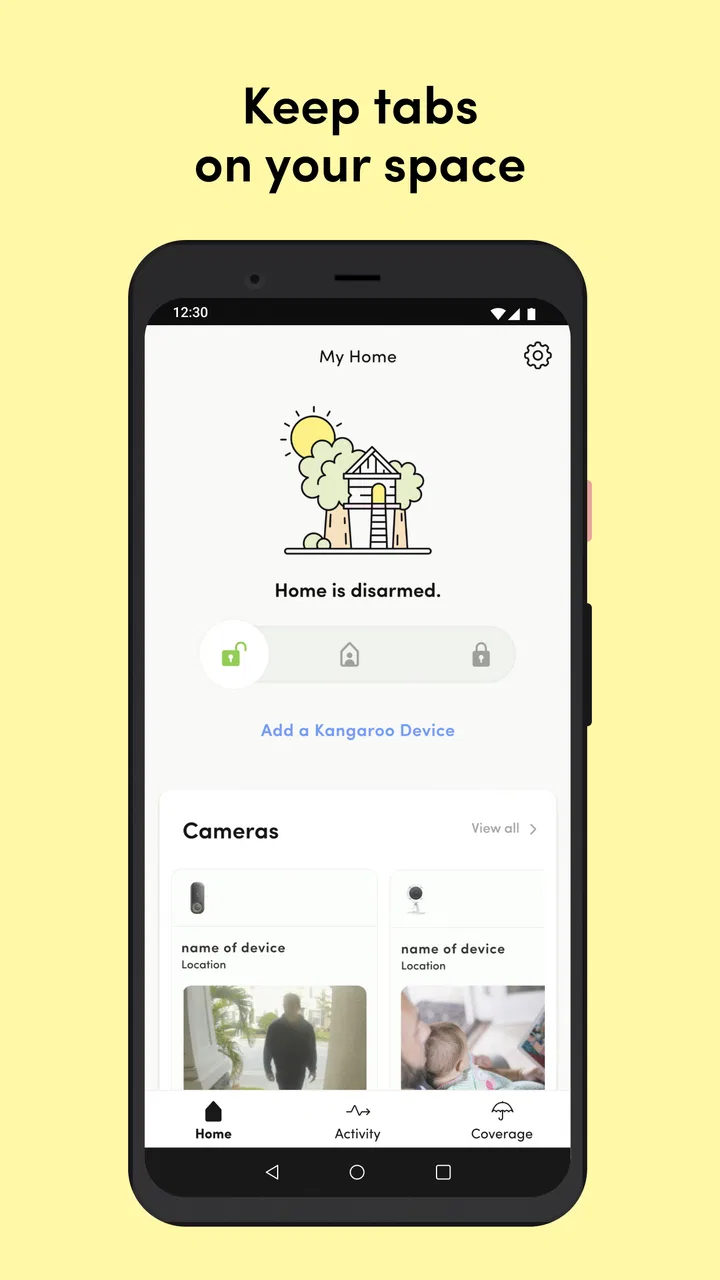
Kangaroo: Simple Home Security
- 3.6
- Rating
- 500.00K
- Installs
- Free
- Price

 Analysis by App-foxy
I approached Kangaroo: Simple Home Security as a practical home-protection app rather than as a substitute for a complete alarm installation. Its purpose is easy to understand: help you keep an eye on your home when you are away. That makes it relevant to renters, families, people living alone, and anyone who wants a simple way to think about home safety from a phone.
The app comes from Kangaroo Security and sits in the House & Home category. It is free, open to everyone by age rating, and available for Android devices running version 7.0 or later. The current version is 11.17.0, and its presence on more than half a million devices suggests that it has found a real audience, even though its average rating is 3.5 from roughly three thousand ratings. I read that combination as a useful warning: plenty of people are trying it, but the experience may not feel equally smooth for everyone.
How clearly the app works for different people and situations
When I judge whether a home-security app works for a household, I look beyond the person who sets it up: different routines, confidence levels, and access needs can change what feels simple. I’d test the key steps with the people who will actually rely on them, then consider where a phone-centered approach fits—and where another option may serve them better.
You May Also Like

 Blood Strike: 2.5 Anniversary
Blood Strike’s Loadouts Turn Every Drop Into a Tactical Gamble
A close look at Blood Strike’s custom loadouts: how fast access to signature weapons reshapes its battle royale rhythm, rewards preparation, and narrows the gap between fights.

 Pandora - Music & Podcasts
Pandora’s Music Is Easy to Start, but Harder to Recover
Pandora’s strength is its low-effort path from a seed to a station. Its weak spot is how much confidence it asks you to place in connection, setup, and quiet recovery.

 8 Ball Pool
 Is Built on Rivalries, Rematches, and Routine
A close look at the rivalries, rematches, shared routines, and unanswered safety questions that turn a quick pool match into a persistent mobile community.

 Samsung Music
’s Quiet Strength Is Playing What You Already Own
Its reach comes less from spectacle than from dependable access to a personal library. That simplicity is both the app’s strongest retention engine and its ceiling.

 AccuWeather: Weather Radar
AccuWeather Review: A Quick, Clear Forecast for Everyday Decisions
For everyday plans, the best forecast is the one you can understand quickly. AccuWeather makes rain timing, radar, and local conditions easy to act on, with a few trade-offs.

 Hill Climb Racing
Why Hill Climb Racing Still Turns Crashes Into One More Run
A tiny car, a bumpy hill and one more upgrade: Hill Climb Racing keeps resurfacing because its simple chaos makes every near-miss feel personal.
More From Our News Desk



Readability and navigation matter more than a long feature list
My first impression of a home-security app is shaped by how quickly I can understand its current state. When I am leaving home, I do not want to decode a complicated dashboard or search through several layers before I know whether protection is active. Kangaroo’s appeal is its straightforward idea: it focuses on home protection from anywhere instead of trying to become a general smart-home control center.
That simplicity can be especially helpful for people who are not comfortable with technical products. A user who is setting up protection for the first time is less likely to feel lost when the app keeps attention on the home rather than presenting a crowded collection of controls. It also makes the product easier to explain to a family member who may use it occasionally rather than every day.
Still, simple does not automatically mean accessible. A clear screen can become frustrating if important status information is too subtle, if labels are vague, or if a user has to remember what each state means. For someone with reduced vision, color-blindness, dyslexia, or attention-related difficulties, I would want every important condition to be communicated with plain text and a noticeable visual distinction, not color alone. I found this to be one of the most important things to check during setup: do not assume that a green or red indicator will be enough for every person using the account.
For shared homes, I would also make the first session a guided walkthrough. I would ask another household member to open the app and identify the home status without help. That small test reveals more than a quick glance at the interface. If the person can tell whether the home is protected, what action is available next, and whether anything needs attention, the app is doing its job well for that household. If they need repeated explanations, the problem is not their ability; the design is asking too much from memory.
Motor and sensory needs change the value of a security app
Security tools are often used in a hurry. I might be standing at the front door with shopping bags, moving through a dim hallway, or trying to check the home while dealing with a child. That makes large, well-spaced controls more valuable than decorative design. A person with limited dexterity, tremors, joint pain, or one-handed use needs actions that do not depend on tiny targets or precise swipes.
I would be cautious about relying on the app if a user regularly struggles with touchscreens. Before making it the only way to manage home protection, I would test the main action with the person who will actually use it. Can they open the app, recognize the status, and activate the required control without accidentally pressing something else? Can they do that while holding a phone in one hand? These are practical accessibility questions, and they are more important than whether the interface looks modern.
People with hearing loss also need a security workflow that does not depend entirely on sound. A visual confirmation is essential when an action changes the home’s state. Likewise, users with low vision may need system text enlargement, display magnification, or screen-reader support. I would check how the app behaves with those phone settings enabled before depending on it for daily protection. I would not treat compatibility with a device’s accessibility tools as guaranteed simply because the app is available on Android.
There is a useful trade-off here. A minimal home-security interface can reduce cognitive load, but it may also hide context that some users need. Someone with memory difficulties may benefit from a very explicit status message and a clear explanation of what to do next. Someone with sensory sensitivity may prefer fewer alerts and less visual noise. The best setup is therefore personal: keep the app’s central task visible, then remove unnecessary distractions from the phone itself where possible.
Situational access is where the app has its strongest everyday value
The phrase “from anywhere” becomes meaningful in ordinary situations, not just emergencies. Imagine leaving for work and wondering whether the home was secured. A quick check from the phone can be reassuring. Imagine a relative who cannot easily move around the house checking the home’s protection without walking to a wall-mounted panel. Or consider a renter who cannot install a complicated permanent system and wants a phone-centered approach instead.
For me, the most realistic use is a shared routine. One person leaves first, another leaves later, and both need to understand the current state rather than assume the other person handled it. I would agree on a simple household rule: whoever leaves last checks the app and says out loud what the status shows. That combines the phone with a human confirmation, which is useful for older adults, people with memory issues, or anyone who may be distracted while leaving.
The app can also suit people who travel frequently or spend long periods away from home. A phone-based check is more convenient than depending on a neighbor to visit just to confirm that everything is in order. However, convenience should not be confused with complete coverage. A remote app is only as dependable as the phone, the account, the home setup, and the connection involved. I would not use it as the sole plan for a vulnerable person, a valuable property, or a home that needs professional monitoring.
Situational access also includes language, confidence, and familiarity with smartphones. A person who rarely uses apps may find the concept approachable but still need help with the initial setup. I would install it together with that user, write down the household routine in plain language, and practice the main action once or twice. That is a better approach than handing over the phone and assuming the simplicity of the product will solve every learning barrier.
Compared with a traditional alarm panel, a phone-based experience is more portable and familiar. Compared with a full smart-home platform, it is less likely to overwhelm someone who only wants a security-focused tool. The trade-off is that conventional systems can offer dedicated controls, stronger installation support, or more obvious physical feedback. A broad smart-home platform may also be preferable for someone who wants security combined with lighting, locks, cameras, and automation in one place.
What I would check before relying on it
The first barrier is setup. A security app can feel easy after it is configured, while the initial process still demands careful reading, account management, and decisions about who should use it. That is where users with cognitive disabilities, limited technical confidence, or motor difficulties may need assistance. I would avoid completing setup in a rush. Instead, I would use good lighting, keep the phone charged, and pause after each major step to confirm that the home status is understood.
The second barrier is the danger of false confidence. A neat phone screen can make protection feel more complete than it really is. Kangaroo: Simple Home Security should be viewed as one part of a home-safety plan, not as proof that every risk has been covered. I would still use ordinary habits such as checking doors and windows, keeping emergency contacts available, and making sure everyone in the household knows what to do if something seems wrong.
A third issue is shared access. In a home with several people, the app is only inclusive if everyone understands who can change the status and how to recognize the result. A household should decide whether one person manages the account or whether several people need access. I would be particularly careful when setting it up for an older relative or a person who depends on a caregiver, because unclear responsibility can create more stress instead of reducing it.
There is also the question of attention. Frequent notifications, confusing prompts, or an unclear distinction between information and action can make a security tool tiring to use. I would review the phone’s notification behavior after the first few days and remove anything that does not help the household make a decision. The goal is not to produce constant activity; it is to make important information easy to notice when it matters.
People who need advanced accessibility controls should test the app on their own device before committing to it. Larger system text, screen-reader navigation, voice control, high-contrast settings, and alternative input methods can behave differently from one phone to another. I would not promise that every one of these tools will work perfectly. The responsible choice is to test the exact combination of phone, operating system, and user needs, then keep a backup method for managing the home.
Who should use it, and who should choose something else?
I think this app is most suitable for someone who wants a focused home-security companion and prefers using a phone instead of learning a large smart-home system. It may be a good match for renters, small households, relatives who need remote reassurance, and people who want to begin with a free product. The Everyone age rating also makes it broadly approachable, although children should not be given responsibility for household security simply because they can open the app.
I would recommend extra care for anyone who needs guaranteed professional response, a physical control panel, extensive integrations, or a clearly documented accessibility workflow. In those cases, a professionally installed system or a more mature home-automation platform may be a better choice. The same is true for users who cannot reliably operate a touchscreen or who live in a situation where phone access, battery life, or connectivity cannot be assumed.
The app’s public reception supports a balanced view. It has gathered around three thousand ratings, about one and a third thousand written reviews, and an average of 3.5. Those figures show meaningful adoption, but they do not make the experience universally dependable. I would treat the rating as a reason to test the app personally rather than as either an endorsement or a rejection. Home-security software has unusually high stakes, so a short trial with the actual household matters more than a popularity number.
My inclusive verdict after considering real household use
Kangaroo Security has made a sensible choice by keeping the product focused on home protection rather than burying the main purpose under unrelated tools. I like that it is free, familiar to people who already use smartphones, and available on older Android versions from 7.0 onward. The current release, 11.17.0, gives users a contemporary version to evaluate, while the app’s broad adoption shows that it is not an obscure experiment.
My recommendation comes with a condition: test it with the person who has the greatest difficulty using it, not only with the most confident smartphone user in the home. Check whether the text is readable, the status is understandable without color, the controls are easy to touch, and the main workflow remains manageable when the user is tired or distracted. Those checks uncover barriers that a quick demonstration can miss.
The strongest reason to choose Kangaroo is its focused, phone-centered approach; the strongest reason to hesitate is that simplicity does not replace a complete accessibility and safety plan. For everyday reassurance and a straightforward starting point, I can see why people would choose it. For professional monitoring, complex properties, or users who need guaranteed support for alternative input and sensory needs, I would look beyond it.
In the end, I would recommend trying it as part of a shared household routine rather than treating it as a magic solution. Set it up calmly, practice the essential action, agree on who checks the home, and keep a backup plan. Used that way, this House & Home app can make remote awareness easier without asking users to become security experts first.
FAQs for Kangaroo: Simple Home Security
01What features does Kangaroo: Simple Home Security offer?
Kangaroo: Simple Home Security provides a range of features designed to enhance home safety. These include motion sensors, doorbell cameras, and entry sensors. The app also offers 24/7 professional monitoring, instant alerts, and easy integration with smart home systems. It's designed for quick setup and user-friendly operation, making home security accessible to everyone.
02Is Kangaroo: Simple Home Security compatible with my existing smart home devices?
Yes, Kangaroo: Simple Home Security is compatible with many popular smart home systems. It integrates seamlessly with devices such as Google Assistant and Amazon Alexa, allowing you to control and monitor your security system using voice commands. This compatibility enhances convenience and provides a cohesive smart home experience.
03Does Kangaroo: Simple Home Security require a subscription?
Kangaroo offers both free and paid subscription options. The free plan includes basic features, while premium plans provide enhanced security options like professional monitoring and additional cloud storage. Subscription plans are flexible, allowing users to choose based on their specific security needs and budget constraints.
04How easy is it to install Kangaroo: Simple Home Security devices?
Installation of Kangaroo: Simple Home Security devices is straightforward and designed for DIY setup. The app provides step-by-step instructions, and most devices are wireless, eliminating the need for complex wiring. Users typically complete installation in minutes, without professional assistance, making it ideal for renters and homeowners alike.
05What should I do if I encounter issues with the Kangaroo app or devices?
If you face any issues with the Kangaroo app or devices, the company offers comprehensive customer support. Users can access troubleshooting guides within the app, contact support via email, or use live chat for real-time assistance. Kangaroo is committed to providing reliable customer service to ensure a seamless user experience.
Pros
- Easy-to-install setup with no tools required.
- Affordable subscription plans for all budgets.
- Real-time alerts provide instant notifications.
- User-friendly interface with intuitive controls.
- Flexible customization for different security needs.
Cons
- Limited camera resolution compared to competitors.
- No integration with some major smart home systems.
- Requires a stable internet connection at all times.
- Lacks advanced features like facial recognition.
- Customer support response times can be slow.

Kangaroo: Simple Home Security
Gallery